The Department of Computer Science at the University of Toronto has several faculty members working in the area of machine learning, neural networks, statistical pattern recognition, probabilistic planning, and adaptive systems. In addition, many faculty members inside and outside the department whose primary research interests are in other areas have specific research projects involving machine learning in some way.
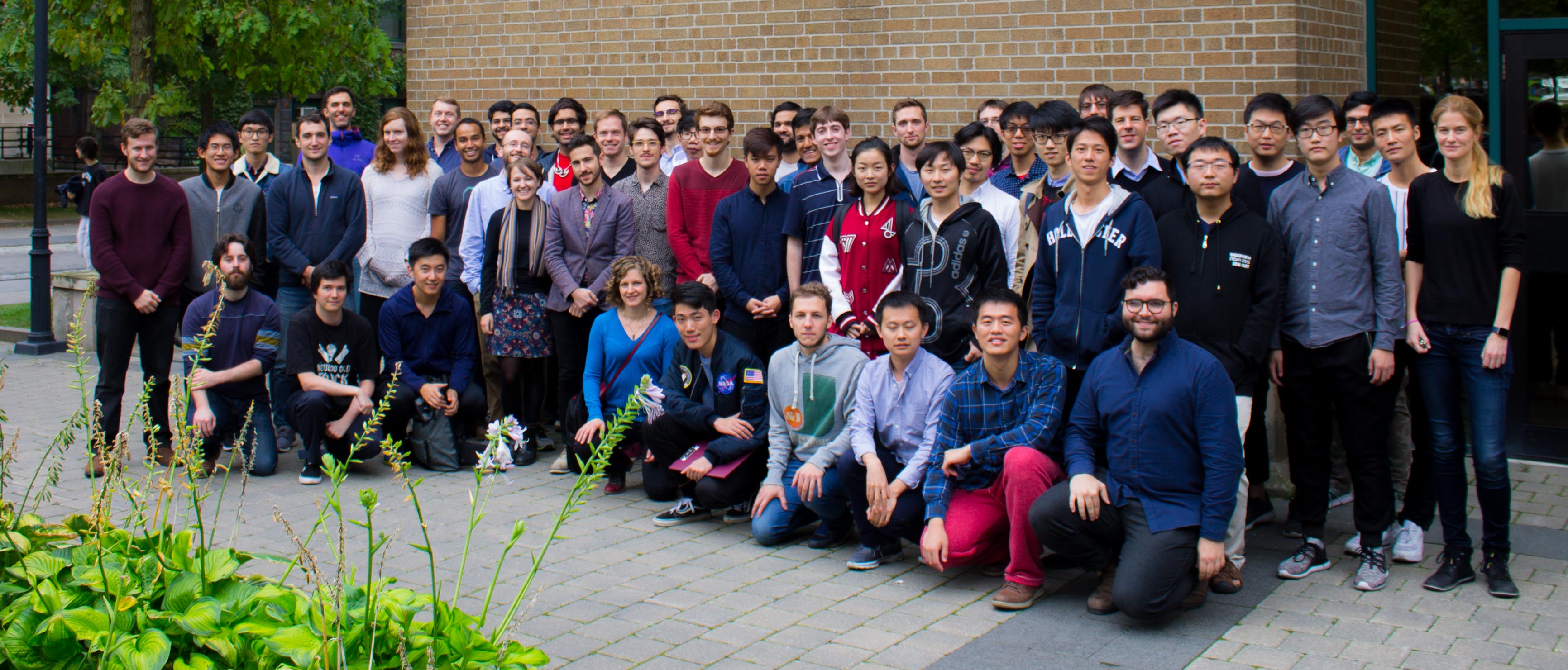
We welcome three new faculty members to the ML group: David Duvenaud, Sanja Fidler, and Roger Grosse.
Congratulations to Michael Wainberg, Victoria Dean and Omar Wagih on their summer projects, which used machine learning to understand the genetics of disease (3rd, 4th and 5th from left).
Checkout http://www.deepgenomics.com/ for more details.
Phylo* is a family of statistical methods that use nonparametric Bayesian tree priors to infer clonal evolution of tumors from whole genome sequencing data. References Amit G. Deshwar, Shankar Vembu, Christina K. Yung, Gun Ho Jang, Lincoln Stein, Quaid Morris. PhyloWGS: Reconstructing subclonal composition and evolution from whole genome sequencing of tumors. Genome Biology 16:35, 2015. http://genomebiology.com/2015/16/1/35/abstract https://github.com/morrislab/phylowgs […]
Check out the exciting deep learning research in our group and the new website for deep learning projects! http://deeplearning.cs.toronto.edu/
pqR is a new version of the R interpreter. It is based on R-2.15.0, distributed by the R Core Team, but improves on it in many ways, mostly ways that speed it up, but also by implementing some new features and fixing some bugs.
SHRiMP is a software package for aligning genomic reads against a target genome. It was primarily developed with the multitudinous short reads of next generation sequencing machines in mind, as well as Applied Biosystem’s colourspace genomic representation.